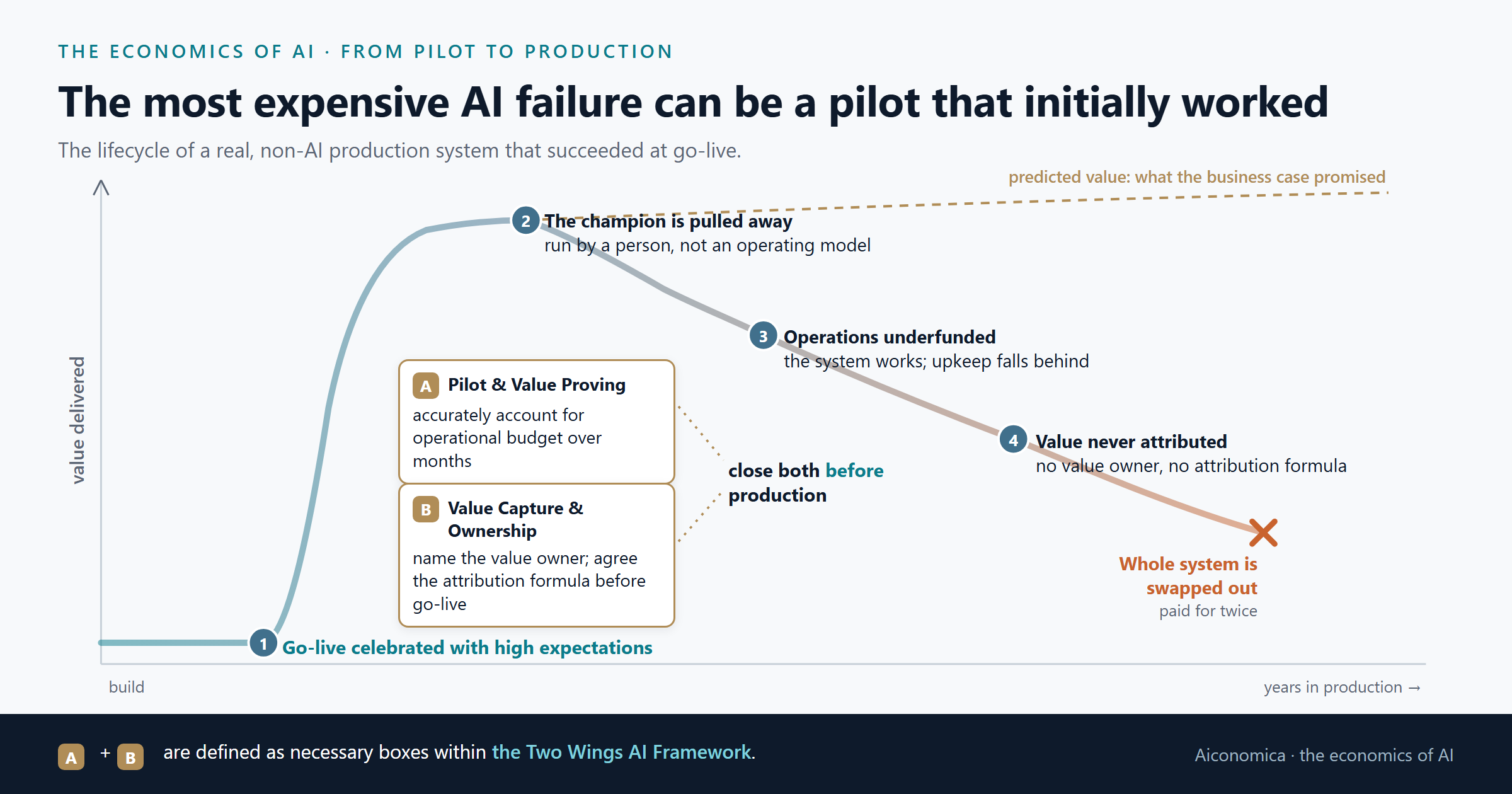
This is a real story from my long career in software solutions design and implementation.
Years before anyone said "AI pilot," a telecom service provider went live with a loyalty platform. It did exactly what it was built to do: it read real subscriber usage (call volumes, SMS, web browsing, whether the bill was paid on time) and granted accurate loyalty points against it, in production, day after day. Go-live was celebrated, and rightly. The engineering was sound, and I can say that with some authority, because it was my work. I was the product manager for that loyalty solution at a leading software vendor, my employer at the time, and I designed and implemented it.
What had not been sufficiently built was the operating and ongoing maintenance side. The budget for operational follow-up was thin. The running of the platform settled, as these things quietly do, on one capable champion in the IT department. A champion is a person, not an operating model. When he was needed elsewhere, the platform kept granting points, but with far less tending than a production system needs.
And the value? The business case had been approved on a prediction: loyal subscribers stay longer, churn goes down. Loyalty and churn were high on the CXO agenda; those KPIs were watched closely. What was missing was attribution: no predetermined formula set out what percentage of the loyalty and churn movement counted as the platform's contribution. So the platform's value stayed inside KPIs it could never claim.
So the platform starved, slowly, over several years, in production. It kept working, but the quality of the data it was ingesting was not regularly monitored and remedied, which led to performance degradation and customer dissatisfaction. Eventually it was swapped out for a replacement that cost more than the original, and that faces the same fate unless the two questions skipped the first time get asked the second time.
Count what that failure cost. The full build. The integration. Months of production running on inadequate resources. The quiet loss of a capability the business had learned to count on. Then the full price of a successor. A pilot that fails costs you a lesson. A production system that succeeds without an owner costs you the system twice.
It failed because it worked
Here is the uncomfortable part: this platform cleared every bar today's AI pilots are straining toward. It reached production. It was accurate at go-live. It ran for months. And it still became the most expensive kind of failure, because success is precisely what exposes the two disciplines a business case can skip.
A) Proving the economics of the operating state. The business case proved the build. The running was never proven with the same rigor: what it costs to keep the system fed, tended, and trusted for months, and whether the prize was still worth that. The question that settles it, asked before production: if this works, is it still worth owning, for months?
B) Owning the conversion of gains into value. "Reduced churn" justified the investment. But without a predetermined formula attributing a share of the KPI's movement to the platform, that value could never be claimed, and what cannot be attributed cannot be owned. The question: who owns the value line? A name, a mandate, a number expected to move, and the attribution formula, agreed before go-live.
AI amplifies the costs of traditional business support systems failure
Today's AI pilots are being promoted into exactly this production life, at operating economics that are less forgiving, not more. Inference costs scale with usage. Models drift and need evaluation. Outputs need human oversight. The audit trail needs an owner. And because these systems take decisions autonomously, the clock runs faster: a poorly governed AI system in production can run up, in months, the kind of loss a traditional system takes years to drift into.
Organizational adoption of AI is at 88% (and that word, adoption, is defined broadly here: any use of AI in at least one business function), while agent deployment in production remains in single digits across nearly every business function.[1] Task-level modelling finds that a large share of AI's productivity gain arrives as freed capacity, not removed cost (in one modelled enterprise case, roughly a third), and the reasoned inference is that this becomes business value only when someone deliberately redeploys it.[2] Freed capacity with no owner simply melts back into the working day. And survey evidence points the same way from the governance side: organizations with clearly accountable ownership of their AI controls report markedly higher maturity, and those investing seriously are far more likely to report material earnings impact.[3]
None of that is proof that your pilot will fail. It is evidence that the two skipped disciplines, proving and owning, are still the ones that decide what success costs.
The Two Wings AI Framework is the framework I devised to prevent precisely this kind of failure, and much more.
Many AI initiatives will be promoted to production without either question being asked. Yours does not have to be one of them.
References
- Stanford Institute for Human-Centered AI, The AI Index 2026 Annual Report (April 2026): organizational AI adoption 88% (broadly defined as any AI use in at least one business function); agent deployment in production reported in single digits across nearly all business functions.
- Accenture & The Wharton School, The Age of Co-intelligence (March 2026): modelled enterprise case in which roughly one-third of productivity gains arrived as freed capacity rather than removed cost; growth through deliberate redeployment identified as the dominant value lever.
- McKinsey & Company, State of AI trust in 2026: Shifting to the agentic era (March 2026): survey of ~500 organizations; clearly accountable AI-control ownership associated with average maturity 2.6 vs 1.8 without; organizations investing $25M+ in responsible AI far more likely to report EBIT impact above 5%. Survey-reported, not audited outcomes.