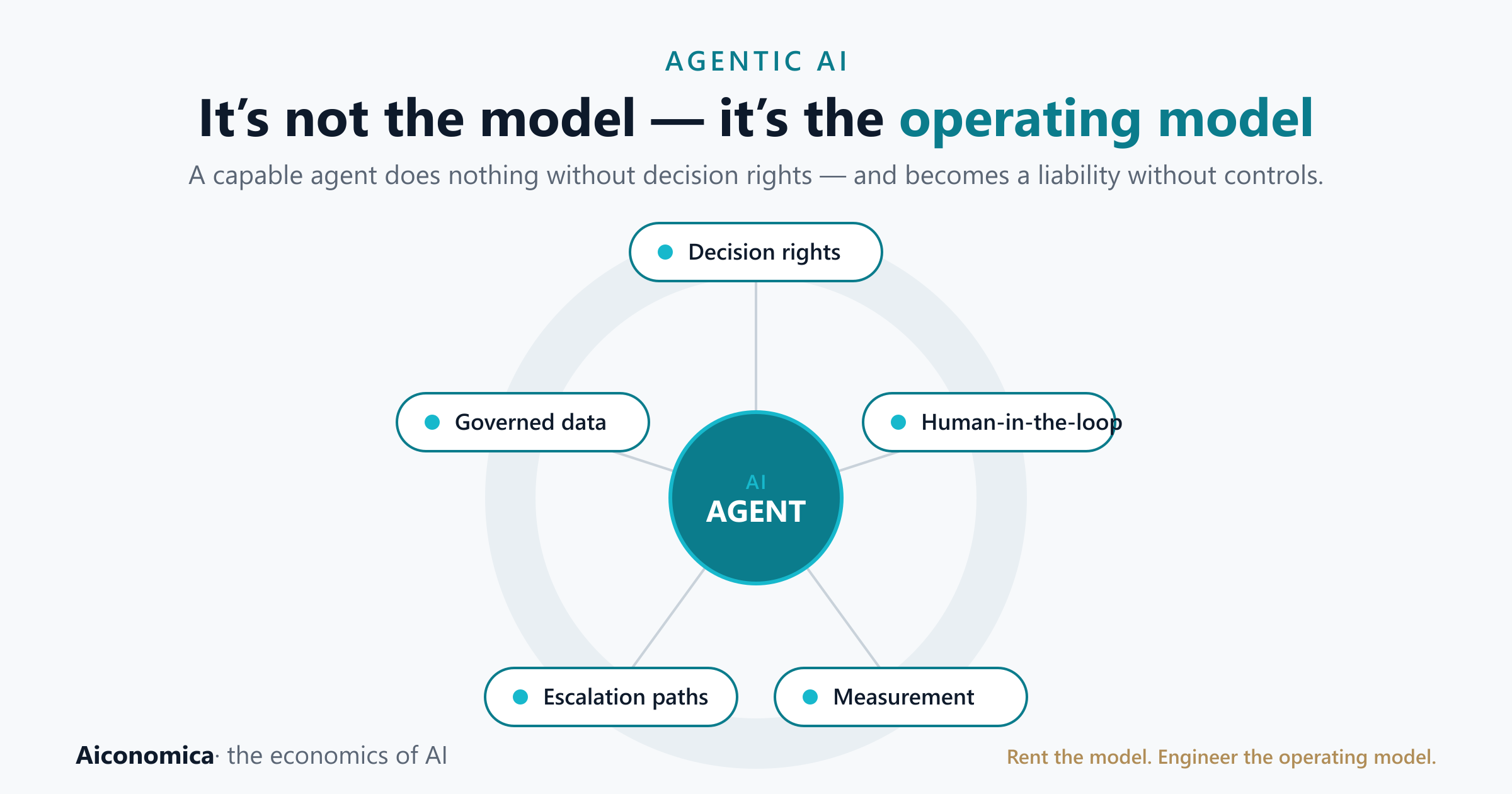
Many organizations add AI agents to org charts built for humans without addressing the accountability gap that follows. An agent changes who decides, who's answerable, and how work flows; that's an operating-model question, not a tooling one. Here's the operating model I'd recommend putting around an agent before it touches a single live process.
The category error
Most "agentic AI" pilots start with a model and a use case — and stop there. But an agent isn't a smarter chatbot; it acts: it reads systems, makes choices, and triggers downstream steps. The moment software does work that used to need a person's judgment, you've changed your operating model whether you planned to or not. Skip that and the pilot either stalls on "who's allowed to let it do that?" or ships and quietly creates risk no one owns.
What changes when work becomes agentic
Three things move:
- Decision rights — which calls an agent makes alone, which need a human to approve, which it must never touch. If you can't draw that line per workflow, you're not ready to deploy.
- Accountability — when an agent gets it wrong, who answers, and can you reconstruct what it did? As HBR argues, you shouldn't treat AI agents like employees — an agent can't hold accountability, so a named human must.
- Flow & control — agents touch data flows, exception handling, and downstream systems. That's the connective tissue Deloitte and IBM describe in redesigning operating models for humans-plus-agents and "agentic operations": the organisation has to decide how work routes between people and agents, and where the controls sit.
The operating model I'd put around an agent
Before it touches a live process, pin down five things — the operating-model discipline I've applied across enterprise transformations, now aimed at a non-human worker:
- Scope & decision rights — the bounded set of actions it may take, and the approval gates above that.
- Human-in-the-loop checkpoints — where a person approves, where they're only notified, where the agent runs autonomously.
- The foundation it stands on — the data, access, and controls it depends on. An agent is only as trustworthy as the governed data beneath it — which is exactly why I run Green Data and Aiconomica as two halves of one value chain, in parallel.
- Exception & escalation — what happens when the agent is unsure or out of bounds.
- Measurement — the few numbers that show it's creating value, not just activity.
None of this is exotic. It's the accountability-process-controls-measurement work transformation has always demanded — applied to a new kind of worker. The worker is novel; the discipline is old.
Why this is an economics question, not only a governance one
The Aiconomica angle: the operating model is what converts an agent's capability into profit. A capable agent with no decision rights does nothing; a capable agent with no controls is a liability. The model itself is the cheap, commoditised part of the equation — you and your competitor can rent the same one this week. The value, and nearly all of the work, sits in everything around it: the decisions you let it make, the people who supervise it, the processes it runs inside, and the change that gets your team working with it. That's the part that actually pays — and it's exactly where I focus when you bring me in: designing the operating model around the agent, not just standing up the model. Rent the model; engineer the operating model.
Where to start
Start narrow and bounded: one workflow, clear decision rights, a human gate, and a number that proves it paid off. Make the run legible — you should be able to watch each step and see what the agent did. Get one workflow right, build the operating-model muscle, then scale.
Agents are arriving whether your operating model is ready or not. The winners won't be the ones with the best model — everyone rents the same models. They'll be the ones who engineered the operating model around it.