Agentic AI is underpinning the new wave of AI-driven enterprise transformation — the AI agents that act on their own to approve refunds, process invoices, and move cases forward, with no one pressing the button each time.
Handing a process to an agent is, first, a business decision — about people and process, not technology.
- People — who owns the work and the outcome once an agent is doing it rather than a person, and whether the surrounding culture is ready to embrace that change.
- Process — lean on enterprise architecture to find the business processes that are the strongest candidates to redesign around an agent.
Each candidate is judged by the return it should produce — first for a single agent (the micro-economics of AI), then across the enterprise, where a deliberate AI strategy compounds those wins into a deep structural transformation (the macro-economics of AI). That transformation is the product of strategy, not luck — without one, it never arrives.
That is the Value vector of our Two Wings AI Framework (TWAF). Its other wing, Trust, turns on the technical question: can the agent be relied on to act? This series starts with Value — and we begin with the process itself: which work is even worth handing to an agent.
A lesson from the last wave of AI
Long before agents, I worked on a problem every telecom operator knows well: churn. In that industry, switching providers is easy and cheap, so keeping customers is a constant, competitive fight — rivals will openly offer incentives to lure each other's subscribers away. Reducing churn sits near the top of the executive agenda.
The tool then was prescriptive AI — a step beyond prediction. A model scored each customer for churn risk and, reading the customer's wider context, prescribed one or two retention offers tailored to them. When a high-risk customer called in, those offers surfaced on the agent's screen, in real time, during the live conversation, and the human operator could offer the right one on the spot. The AI did not act; it put its recommendation in front of a person, who acted, in the moment.
What made that work was not the model. It was the discipline around it — the business case set before a line of code went live. That same discipline is what decides whether handing a process to an agent is worth starting at all.
What makes a process worth an agent
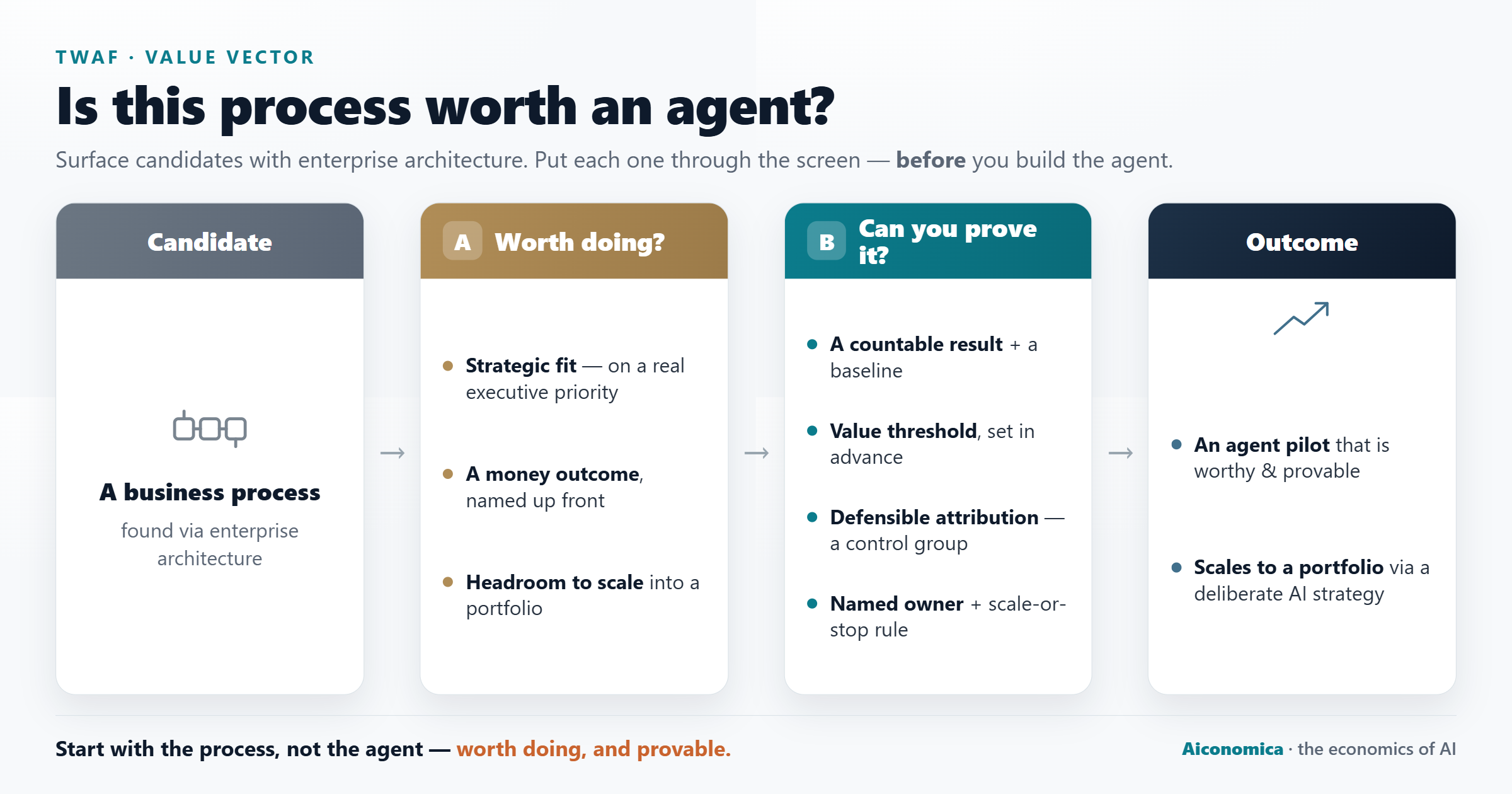
Enterprise architecture is how you surface the candidate processes; what follows is how you judge them. Before you hand one to an agent, it has to earn it — first by being worth doing, then by being provable.
Is it worth doing?
Three things tell you.
Strategic fit. The process has to sit on something the business genuinely cares about. Churn qualified easily — a board-level concern in a fiercely competitive market. Automating a backwater to look busy does not.
A money outcome, named up front. Not how many people use the agent or how many tasks it handles — that is activity, not value — but a number the CFO recognises: cost, revenue, margin, or risk. For churn it was retained revenue. Name it before you start, or you will be left arguing about what success meant after the fact.
Headroom to scale. A good pilot is a door into a domain, not a dead end. Churn reduction was one move inside a larger game telecom operators call Lifetime Value Maximization — whole departments work to grow the value of each customer relationship, and churn is one weapon among many. Winning on churn opened that portfolio.
But the step from one agent to an enterprise-wide gain does not happen on its own; it is the work of a deliberate AI strategy that decides which wins to compound, and how. Strategy is what turns the micro-economics of a single agent into the macro-economics of a transformation.
Can you prove it?
A process can be worth doing and still fail the business case — because you could not show that it worked. Four things keep you honest.
A countable result, measured before you start. The process produces one discrete thing you can count each time it runs — a resolved ticket, a processed invoice, a contacted customer. Measure it before the agent goes live (for churn, the churn rate with no intervention); without that baseline, every later "improvement" is a story, not a result.
A value threshold, set in advance. Decide the bar that makes it worth it before you run, not after. For churn, the retention uplift had to beat the cost of the offers plus the cost of the model. Below that line, the process was not worth automating, however clever the model.
Defensible attribution. This is the one most pilots skip. You have to show the AI caused the result — not the season, not a price change, not chance. In churn, we held back a control group: some at-risk customers received the intervention, some did not, and the gap between them was the real effect. If you cannot attribute the gain, you cannot defend it.
A named owner, and a decision rule. One person owns the outcome, and the pilot ends in a decision — scale it, or stop it. A pilot with no owner and no stopping rule does not end; it quietly drains budget.
Why the discipline pays
None of this is free. A serious pilot is a strategic investment, not a cheap experiment. With a vendor, you can hold cost down by tying part of their reward to the result — skin in the game, not a fixed bill.
Your own people are a different question, and not a cost one: the team asked to make an agent succeed may quietly fear it will one day replace them, and no one does their best work on that fear. Give them a real stake in the outcome — a role on the far side of the change, and the credit for the win — and they put their weight behind it. Even then, expect the pilot to cost real money. The harder truth is that many never reach production at all.[1] Money goes in; nothing comes out.
That is the waste the Value vector is built to reduce. Choosing processes worth doing, and proving they work, is how you raise the share of pilots that reach production — fewer worthy-looking experiments that quietly die, more agents that earn their place.
What changes with an agent
Return to that call-centre screen. The model prescribed an offer; a person decided whether to make it. An agent removes the person from that moment — it would weigh the customer, choose the offer, and act, on its own. The business question is unchanged: is this worth doing, and can you prove it? The stakes are higher, because the system now acts rather than suggests, and a wrong action is not a recommendation a human can quietly set aside.
That is why the business case is only half the answer. Whether the agent can be relied on to act — the data beneath it, the controls around it, the oversight above it — is the other half. Those are the technical success criteria, and they belong to the Trust vector. We will get to them.
Start with the process, not the agent
The foundation of the Value vector is simple to state and hard to practise: do not start with the agent. Start with the process, and the business case for handing it over — worth doing, and provable. Get that right, and the rest of the framework has something solid to build on.
But a worthy process resting on data the agent cannot rely on will still fail. That is the other half of this foundation — and where the next article goes: AI-Ready Data.
Explore the full framework: the Two Wings AI Framework.
Notes
- Gartner predicts at least 30% of generative-AI projects will be abandoned after proof of concept by the end of 2025 — citing poor data quality, inadequate risk controls, escalating costs, or unclear business value (Gartner, July 2024). MIT's NANDA study, The GenAI Divide: State of AI in Business 2025, reaches the same place from the value side: only about 5% of enterprise GenAI pilots achieve rapid revenue acceleration, while the vast majority deliver little to no measurable impact on P&L (MIT NANDA, 2025).