Most enterprises have now run an AI pilot. Far fewer have turned one into measurable enterprise AI ROI — and in my experience the reason has more to do with the data than with the model. The pattern is now visible in the research: in recent McKinsey work, nearly two-thirds of organizations had experimented with AI agents, but fewer than one in ten had scaled them to tangible value — and eight in ten pointed to the same obstacle, their data.
My background is on the data side: years in data management and governance, and more recently the AI strategy that builds on it. From that vantage point, the distance between a convincing pilot and a value-generating production system is usually a data distance. A pilot is typically built on a carefully prepared slice of data. Production depends on the fuller, messier reality — data spread across systems, with varying quality, ownership, and permitted uses. Crossing that distance is real work, and it tends to go better when it is planned and resourced deliberately rather than discovered late.
Return is shaped by the inputs
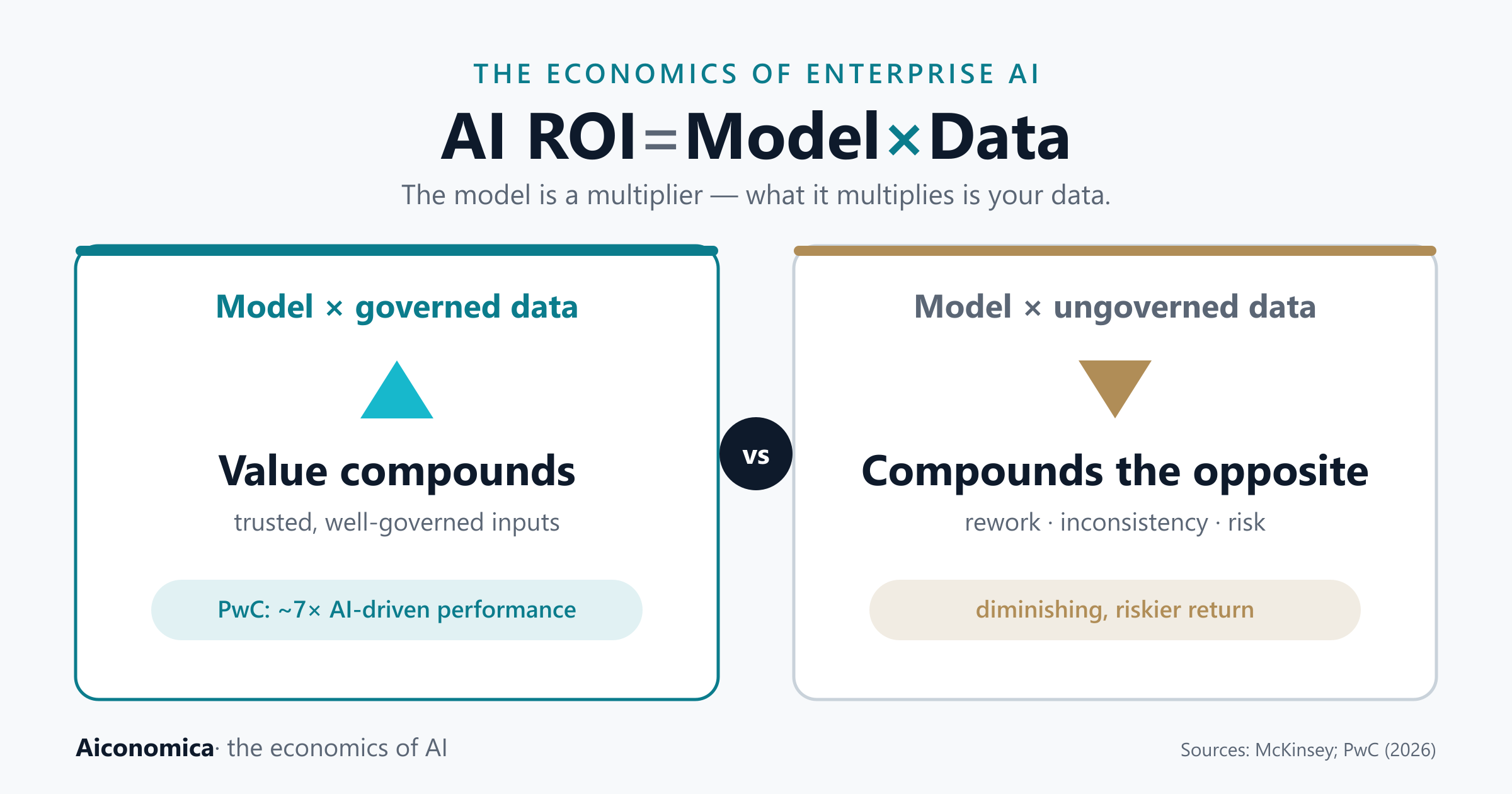
It helps to think of a model as a multiplier. Applied to well-governed, trustworthy data, it compounds value. Applied to data that isn't yet reliable or properly governed, it compounds the opposite — rework, inconsistency, and risk. The returns bear this out: in PwC's study of more than 1,200 companies, the most "AI-fit" — those with the strongest foundations, data and technology among them — delivered roughly seven times the AI-driven financial performance of their peers, and a fifth of companies captured almost three-quarters of the returns. So the return on an AI investment is shaped at least as much by the quality and governance of its inputs as by the sophistication of the model itself.
A familiar pattern
A representative example makes this concrete. A team builds a model to predict customer churn. In the pilot it performs well, trained on a clean, hand-prepared extract. Moving toward production, the same customer turns out to be represented differently across the CRM, the billing system, and the support platform — no shared identifier, and inconsistent definitions of what counts as an "active" account. Accuracy falls, not because the algorithm changed, but because the production data no longer matches the conditions the pilot assumed.
The remedy here isn't a better model; it's resolving identity, quality, and ownership across those sources. That work is comparatively straightforward to plan for early, and considerably more costly to retrofit once the initiative is already underway. The specifics vary, but the shape of the pattern is consistent across use cases.
Planning the foundation alongside the AI
A natural conclusion is that the data should be fixed first, before any AI. In practice that often stalls both: the data programme becomes an open-ended prerequisite, and the AI work waits behind it.
A more effective approach is to advance the two together. The AI use cases clarify which data actually matters, so governance effort can be concentrated where it will be used rather than spread thinly across everything. Improving that data, in turn, raises the performance and trustworthiness of the AI. Each informs the other, and the data foundation is best treated as part of the AI business case rather than a separate line of cost.
In practice
For teams scoping AI value, it is worth assessing data readiness at the outset — the readiness of the data the system will depend on, not only the model. Where there is a gap, the data foundation is a discipline in its own right; my data-management and governance practice, Green Data, focuses on building the governed-data base that enterprise AI relies on, and it is designed to work in parallel with the AI strategy rather than ahead of it. (You can read more about scoping that base under AI & data readiness.)
The short version: enterprise AI ROI is capped by the data foundation beneath it. Fund the foundation, and you fund the return.
I'm Sami Tayara, founder and principal of Green Data, working on the economics of enterprise AI through Aiconomica. If your organisation is moving from AI pilots to measurable return, I'd welcome a conversation about it — get in touch or connect on LinkedIn.